
Top 10 Enterprise AI Transformation Companies
Compare the top AI consulting firms for enterprise AI transformation in 2026: capabilities, delivery models, costs, pros and cons, and how to choose.
Almost every mid-size and large company now pays for AI tools. Engineers have Copilot seats, support runs a chatbot, and someone in finance is testing an agent. Yet when the board asks what it all changed, the answer is usually vague. Around 80% of AI initiatives never deliver measurable business value, and most leaders we talk to can tell you exactly which of their pilots ended up in that 80%.
That gap is why companies look for outside help with enterprise AI transformation. The partners worth paying put working software into production and can show, in numbers, what that software changed. Some firms are great at the thinking part. Fewer can do the building part inside a ten-year-old codebase with a compliance team watching.
What Enterprise AI Transformation Companies Do
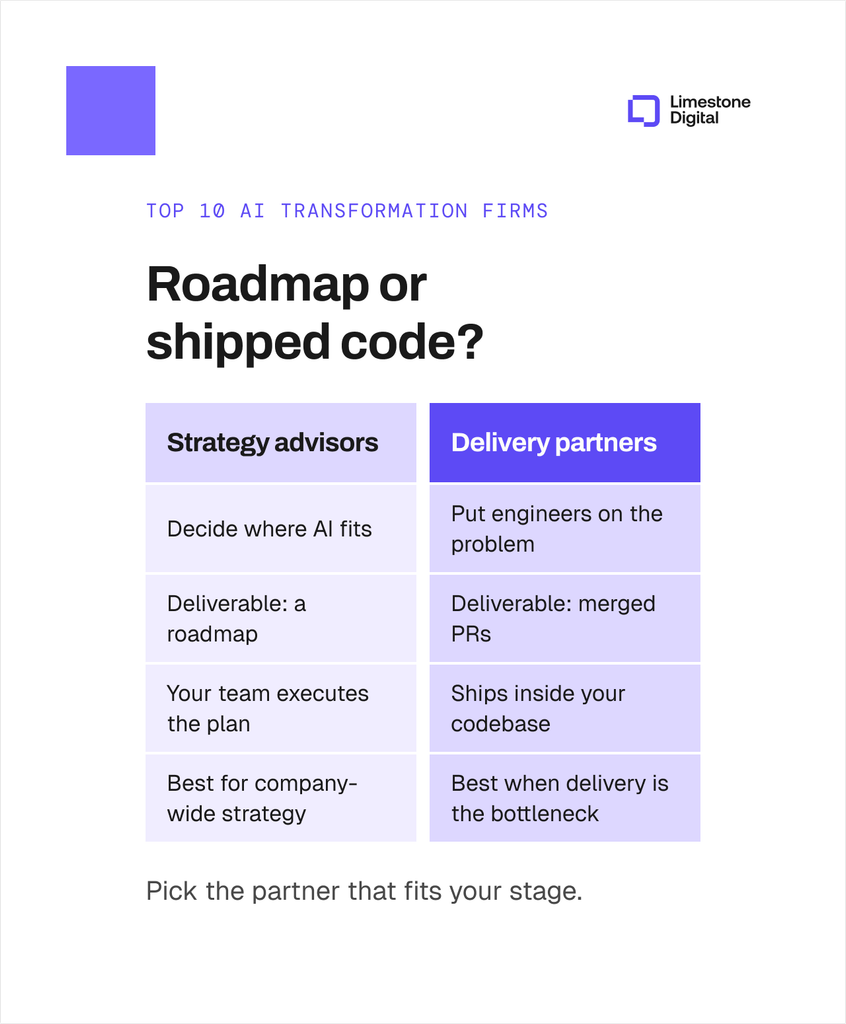
Most firms in this market fall into one of two groups:
- Strategy advisors help leadership decide where AI fits in the business, which use cases to fund, and how to govern them. The deliverable is usually a roadmap.
- Implementation partners put engineers on the problem. They build agents, change workflows, and ship code into your product.
Classic AI transformation consulting ends with a presentation and a plan your team is expected to execute. Embedded engineering ends with merged pull requests, and a team that has learned to keep working that way.
This difference explains why so many AI consulting firms get stuck at the pilot stage. A pilot runs in a sandbox with clean data and a few enthusiastic users. Production brings legacy code, security reviews, and real customers. If the advisor leaves right after the pilot and your team has no spare capacity, the project quietly stops moving.
Top 10 Enterprise AI Transformation Companies in 2026
We compared each company on capabilities, delivery model, and cost. The list mixes the top AI consulting firms, which are strongest on strategy, with delivery-first partners that focus on shipping. Each entry ends with a short pros-and-cons table, so you can quickly scan the trade-offs and see who fits your stage of enterprise AI transformation.
1. McKinsey & Company (QuantumBlack)
QuantumBlack is McKinsey’s AI arm. McKinsey acquired it in 2015, and it now sits at the center of the firm’s work on AI strategy and advanced analytics. As one of the top AI consulting firms, McKinsey’s biggest strength is access. Its partners work directly with CEOs and boards, and it has benchmarks from nearly every major industry.

The trade-off is cost and focus. Engagements are expensive, and they focus more on strategy and operating model design than day-to-day engineering.
Best for: large enterprises setting a company-wide AI strategy.
| Pros | Cons |
| Top-tier strategy and brand | Very high engagement cost |
| Deep industry benchmarks | Strategy-heavy, less hands-on delivery |
2. BCG (BCG X)
BCG launched BCG X in 2022 to bring its tech build and design teams under one roof. It combines classic BCG consultants with engineers, designers, and data scientists, so a strategy can move into an actual product without switching vendors.
That makes it one of the stronger options among strategy firms if you plan to build something new. Expect premium pricing and big engagements that often run for many months.
Best for: enterprises building new AI products.
| Pros | Cons |
| Strong build capability for a strategy firm | Premium pricing |
| Good link between strategy and product | Long, large-scope engagements |
3. Limestone Digital
We run AI transformation as an engineering discipline. Instead of a consulting project that costs hundreds of thousands before anything ships, we embed AI-native engineering pods directly into your team, starting from $17K per month per AI velocity pod. Each pod has one full-time forward-deployed engineer plus a lean support layer: an AI-productivity lead, a PM and BA sized to the work, and a customer success manager. The pod joins your standups, works in your repos, and goes live within two weeks.
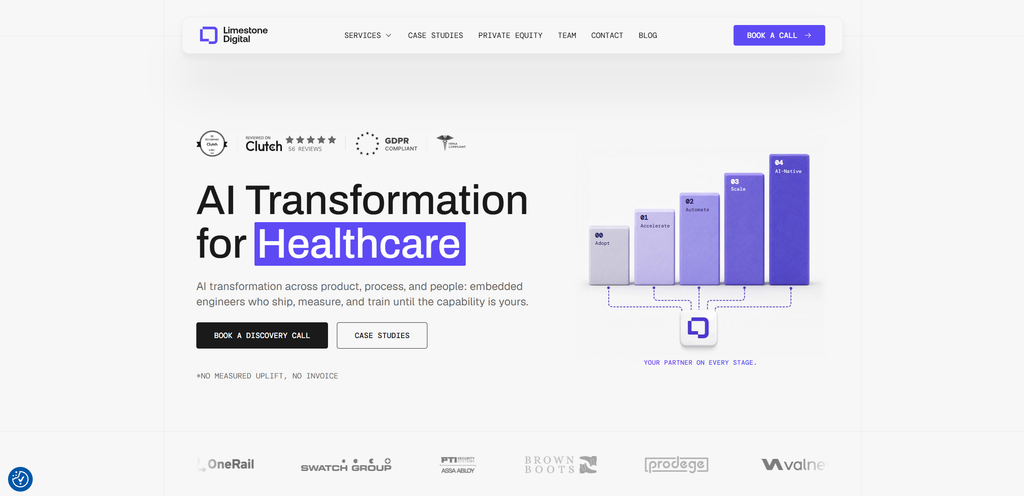
We measure everything weekly on our DevInt dashboards against your baseline. The contract is month-to-month, and the guarantee is built in: no measured uplift, no invoice. For example, one logistics platform delivered 42% faster within two months, worth about $160k a year.
We work mostly on existing products in regulated industries such as healthcare, insurance, lending, and PE portfolio companies. For teams tired of AI transformation consulting that stops at the slides, this model is the practical alternative.
Best for: engineering teams that want hands-on AI implementation inside their existing codebase, with measurable, guaranteed results.
| Pros | Cons |
| Hands-on implementation inside your codebase | Smaller than global consulting firms |
| From $17K/month per AI velocity pod | Not focused on board-level, strategy-only projects |
| Uplift tracked weekly on DevInt dashboards | Focus on existing products over greenfield builds |
| Month-to-month, no measured uplift, no invoice | |
| HIPAA, SOC 2, and GDPR-ready delivery |
4. Accenture
Accenture brings global scale. In 2023, it announced a $3 billion investment in data and AI, and it now has tens of thousands of AI practitioners worldwide. Among large AI consulting companies, it covers the widest range: strategy, platform implementation, and long-term managed services.
Size cuts both ways. Big programs can feel slow and process-heavy, and the total cost adds up quickly once several workstreams run in parallel.
Best for: large, multi-country transformation programs.
| Pros | Cons |
| Huge delivery capacity | Can feel slow and process-heavy |
| Strong partnerships with major tech vendors | High total cost |
5. Bain & Company (Bain Vector)
Bain Vector is Bain’s digital and AI unit. Bain has one of the largest private equity practices in consulting, and that shows in how it approaches AI: the focus is on value creation that a deal team can take to the investment committee.
Bain’s build capacity is smaller than BCG X’s, so for heavy engineering work it often relies on partners. Pricing sits firmly in the premium range.
Best for: PE sponsors and value creation plans.
| Pros | Cons |
| Deep PE expertise | Smaller build capacity than BCG X |
| Results-focused approach | Premium pricing |
6. Deloitte
Deloitte has put agentic AI at the center of its offer, including its Zora AI agents launched in 2025. As a Big 4 firm, it covers strategy, risk, and implementation, and its risk and compliance teams are among the strongest in the market.
That makes Deloitte a natural choice for enterprise AI solutions in heavily regulated sectors. The downside is team size and cost, and delivery quality depends a lot on which team you get.
Best for: regulated enterprises that need AI with solid governance.
| Pros | Cons |
| High risk and compliance focus | Large teams, high cost |
| Broad industry coverage | Delivery quality can vary by team |
7. EY
EY launched its EY.ai platform in 2023, backed by a $1.4 billion investment, and pairs it with an advisory practice. Its strongest ground is finance, tax, and risk, where the firm’s audit background gives it real credibility.
If your AI program sits inside the CFO’s office, EY speaks that language well. Product engineering is not its core strength, and pricing matches its Big 4 status.
Best for: finance-led AI programs.
| Pros | Cons |
| Strong governance and audit expertise | Less focus on product engineering |
| Global reach | Premium pricing |
8. Capgemini
Capgemini is a large IT services and consulting company that builds and runs enterprise AI solutions at scale. In 2025 it acquired WNS to strengthen its AI-driven operations and business process services.
Its engineering and operations teams are strong, and it’s a good fit for multi-year managed services. Strategy work is less deep than at McKinsey, BCG, or Bain, and contracts tend to be long.
Best for: IT modernization with AI built in.
| Pros | Cons |
| Strong engineering and operations | Less strategic depth than MBB |
| Good for long-term managed services | Long contracts |
9. Adastra
Adastra is a data and AI consultancy headquartered in Toronto. It focuses on the foundation layer: data engineering, analytics, and cloud. That work is less visible than a flashy AI demo, but most AI projects fail without it.
Adastra is more flexible and easier to work with than the giants. Its global footprint and strategy offer are narrower.
Best for: companies fixing their data before scaling AI.
| Pros | Cons |
| Strong data engineering | Smaller global footprint |
| More flexible than big firms | Narrower strategy offer |
10. Publicis Sapient
Publicis Sapient, part of Publicis Groupe, has decades of experience in digital business transformation. Its current AI work focuses on moving companies from experiments to real execution, especially on customer-facing platforms.
It knows retail, banking, and consumer brands well. There’s less public data on the size of its AI engineering talent, and it fits B2C projects better than deep technical work.
Best for: customer-facing and digital platforms.
| Pros | Cons |
| Long digital transformation track record | Less public data on AI talent |
| Strong customer experience focus | Better fit for B2C than deep tech |
How to Choose the Right AI Transformation Partner
Start with one honest question: do you need a strategy, or do you need shipped, measured results? Many AI consulting firms do the first very well. If your roadmap is already clear and delivery is the bottleneck, look for a partner that works inside your codebase.
Then compare how AI consulting companies charge. Fixed-scope projects give you a predictable total but lock you into a plan written before anyone knows the details. Monthly pods, like the model we use, let you scale up or stop based on results. We explain how this works in our article on forward-deployed engineers and what they cost.
Before you sign, ask every candidate:
- Have you worked with our stack and with legacy code of a similar age?
- How do you handle our compliance rules (HIPAA, SOC 2, GDPR)?
- Which metrics will you track, and against what baseline?
- What happens if the numbers don’t improve?
The last answer tells you a lot about how much a partner believes in its own work.
Conclusion
The top AI consulting firms are a strong choice when you need a company-wide strategy and board-level alignment. Delivery partners fit better when the plan exists, and the real problem is getting AI into production. Whichever you pick, make sure the partner measures uplift against your own baseline, because industry averages won’t convince your board.
If you want to start your enterprise AI transformation with shipped code instead of another deck, talk to us. Limestone Digital has helped 170+ teams move from AI-absent to AI-native, and you can see the results in our case studies. We’ll look at your delivery pipeline, find where AI will pay off first, and tell you honestly if we’re the right fit. Book a discovery call.
